
WOCEC Leaders Presented at New Jersey State Conference: Advancing the Pipeline for Women of Color in Educational Leadership
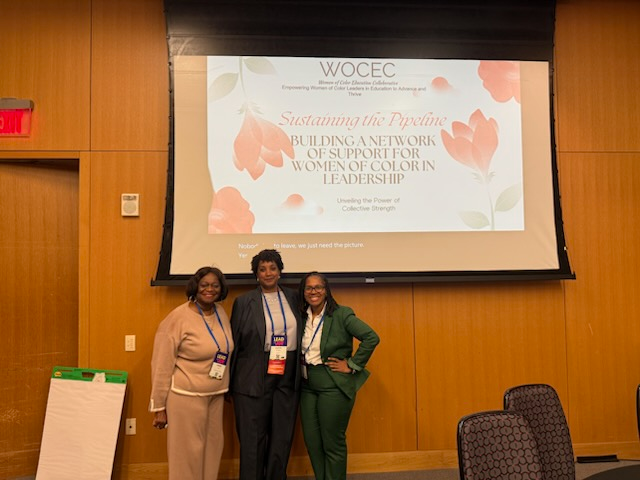
The WOCEC continues to lead the statewide conversation in New Jersey on equity in educational leadership. At the recent New Jersey Principal and Supervisor Association (NJPSA) fall leadership conference in Atlantic City, executive coach Dr. Denise Lowe, WOCEC cohort 3 member Dr. Kayla Lott, and cohort 1 member Dr. Danita Ishibashi presented an empowering session titled Sustaining the Pipeline: Building a Network of Support for Women of Color in Leadership.
The session drew a diverse audience of school and district leaders who engaged in meaningful dialogue about the realities and opportunities facing women of color in education today. The opening activity—“In this political climate, in one word, describe what you feel it is like to be a woman and/or a woman of color in educational leadership”—set the tone for a powerful discussion.
Elevating Solutions, Not Just Identifying Challenges
Rather than dwelling on obstacles, the presenters centered the session on research-based strategies to strengthen the leadership pipeline, increase retention, and build the capacity of women of color leaders. Participants walked away with practical tools and a curated list of strategies for:
- Hiring with intentionality
- Creating environments that retain diverse leaders
- Building capacity through mentorship and executive coaching
- Transforming organizational culture to reflect inclusive leadership values
A Call to Action
The message was clear: the leadership pipeline for women of color is not only a matter of representation—it is also a matter of educational excellence, innovation, and equity. The WOCEC is leading the charge, but sustaining the pipeline requires active participation from districts, institutions, and allies committed to systemic change.
Now is the time to:
- Invest in coaching and mentorship programs
- Advocate for equitable hiring and promotion practices
- Build networks of support within leadership spaces
- Amplify the voices and visibility of women of color leaders
The WOCEC is the Network That Sustains the Work
As WOCEC members continue to elevate the conversation at statewide platforms, we invite all leaders to move from awareness to action. The work is critical, and the time is now.
More News About WOCEC Alumna

Here’s more great news about WOCEC alums:
Former WOCEC cohort member Dr. Kayla Lott won the Democratic nomination for 5th ward council person in Union County/Linden, NJ. She will be unopposed in the general election this November.
At the start of July, Highland Falls-Fort Montgomery (NY) Central School District tapped WOCEC alumna Dr. Crystal Waterman to be the new assistant superintendent for curriculum, instruction and technology. Dr. Waterman had been a principal in the Mount Vernon (NY) Central School District.
And congratulations to Dr. Kaweeda Adams, WOCEC executive coach, who last week defended her doctoral dissertation, entitled Exploring the Relationship Between Ethical Leadership Characteristics and the Ethical Actions Among School Superintendents in New York State.
New Book from Learning Policy Institute: District Leadership for Racial Equity: Lessons From School Systems That Are Closing the Gap

District Leadership for Racial Equity—developed through the Southern Education Foundation’s Racial Equity Leadership Network—shows how purposeful, equity-driven leadership can spark change across diverse school districts. Drawing on case studies from four districts, the collection highlights how leaders have reduced disparities and improved outcomes for students of color by building the will and capacity for systemic reform. While acknowledging the challenges inherent in this work, the cases demonstrate that meaningful progress is possible when district leaders take intentional, sustained action. This resource offers valuable insights for emerging and practicing leaders as well as policymakers, who are committed to advancing racial equity and creating better opportunities for historically marginalized students.
Education Week: Women and People of Color Underrepresented in Superintendent Ranks

This Education Week July article draws on the 2024–25 AASA superintendent salary and benefits survey to show that despite modest shifts, women and people of color remain significantly underrepresented at the superintendent level. White men continue to dominate the position; about 73 % of superintendents are male, and the share of white superintendents remains high (though it has declined slightly over recent years). Among underrepresented groups, small gains are evident (for example, Black and Hispanic superintendents have inched upward), but these increases are marginal. The article highlights disparities in educational credentials: female and non-white superintendents are more likely than their male or white counterparts to hold doctoral degrees, which some interviewees interpret as a “safety mechanism” (i.e., needing to overqualify to be competitive). It also discusses pressures and deterrents discouraging more diverse candidates (e.g. bias, “DEI-hire” stigma, district politics) and notes retention challenges. To support leaders from underrepresented demographics, the article underscores the importance of mentorship, affinity groups, professional networks, and structural changes in hiring and retention practices.